



Skin Aging: What Role Do Antioxidants in Vegetable Oils Really Play?

As time goes by, the skin naturally changes: it can become drier, gradually lose elasticity, and develop fine lines or an uneven complexion. But behind these visible changes lie complex biological mechanisms, including oxidative stress, which plays an important role.
This is where antioxidants come into play. Naturally present in certain vegetable oils, they are increasingly sought after in skincare routines. But what exactly are they? How do they work on the skin? And can a vegetable oil rich in antioxidants really slow down the signs of aging?
Naturoleum helps you understand it all in a simple and scientific way.
What actually happens when the skin ages?
Skin aging is a natural process influenced by several factors. Some of it is linked to age and the biological mechanisms naturally occurring in our bodies: this is known as intrinsic aging.
Another part is influenced by our environment. Ultraviolet rays, pollution, and certain external aggressions can contribute to the production of reactive oxygen species, commonly known as free radicals or ROS (Reactive Oxygen Species).
When their production exceeds the skin's natural defense capacity, an imbalance known as oxidative stress can occur.
This phenomenon can affect lipids, proteins, and various cellular structures in the skin. Over time, it contributes to the mechanisms associated with skin aging and photoaging, particularly as a result of UV exposure.
Free radicals and antioxidants: a question of balance
To understand the role of antioxidants, imagine a system that needs to remain balanced.
Free radicals are highly reactive molecules naturally produced by the body, particularly during normal cellular activity. They are therefore not inherently "bad": they also play a role in certain biological functions.
The problem arises when they are produced in excessive amounts or when the body's antioxidant defenses are no longer sufficient to maintain balance.
Antioxidants can then help neutralize certain reactive species and limit certain oxidation reactions. The skin itself has its own antioxidant defense systems, both enzymatic and non-enzymatic. These include vitamin C, vitamin E, and glutathione.
The goal is therefore not to completely eliminate free radicals, but to help maintain balance.
Why are antioxidants found in certain vegetable oils?
Not all vegetable oils contain the same molecules. Their composition varies depending on the plant, the part used, the extraction method, and storage conditions.
Some oils are naturally interesting because of their antioxidant compounds, particularly vitamin E (tocopherols) and various plant-based compounds.
Vitamin E is especially interesting in cosmetics because it is fat-soluble and has antioxidant activity. It can help protect lipids from oxidation.
This is one of the reasons why certain vegetable oils are particularly appreciated in skincare routines designed for mature skin or skin exposed to environmental stressors.
Which vegetable oils are particularly interesting?
Argan oil is naturally rich in fatty acids and also contains vitamin E. It is valued in cosmetics for its nourishing and protective properties, making it an interesting oil for skin lacking comfort and suppleness.
It can be used on its own or incorporated into a more comprehensive skincare routine.
Highly valued in cosmetics, prickly pear seed oil contains fatty acids and vitamin E.
Its composition makes it particularly popular in skincare products designed for dry and mature skin, especially when the goal is to maintain the skin's suppleness and radiance.
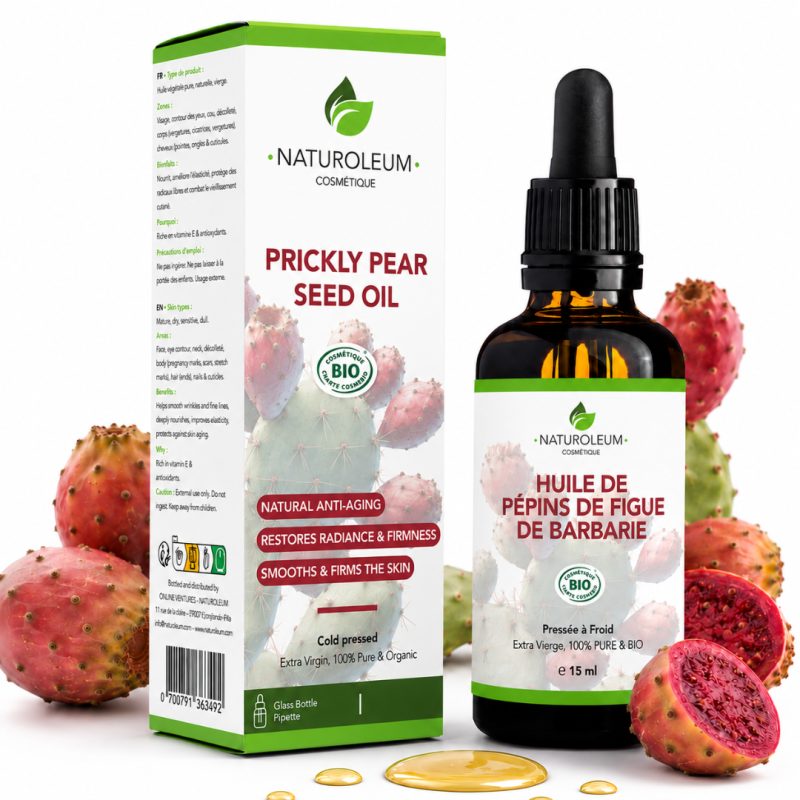
To learn everything about this precious oil, read our article prickly pear seed oil: benefits and uses.
Avocado oil has a rich texture and an interesting lipid profile for dry skin. It is particularly suitable when the skin needs additional comfort and nourishment.
It can also be used on certain dry areas of the body.
Softer and highly versatile, sweet almond oil is appreciated for its comfortable feel and nourishing properties.
It can be incorporated into a daily routine when the goal is to maintain the skin's suppleness and comfort.
Antioxidant does not mean "miracle anti-aging"
This is probably the most important point to remember.
A vegetable oil rich in antioxidants will not stop the skin's natural aging process. Nor will it instantly erase wrinkles or repair all the damage caused by UV exposure.
Research into antioxidants in dermatology is promising, but their effects depend on factors such as the molecule involved, its concentration, its stability, and its ability to reach different layers of the skin. Clinical evidence varies depending on the antioxidant and formulation used.
The value of vegetable oils therefore lies more in their complementary role within a complete skincare routine than in the promise of a spectacular anti-aging effect.
How can you incorporate antioxidant-rich vegetable oils into your routine?
Using them can be very simple.
After cleansing your skin, apply a few drops of the vegetable oil suited to your needs to your face. Warm the oil gently between your hands, then massage it into your skin until absorbed.
For dry or mature skin, regular use can help maintain a feeling of comfort and suppleness.
You can also apply certain oils to the neck, décolleté, or dry areas of the body.
The key is consistency: there is no need to use a large amount of product. A few drops are generally enough for the face.
What about UV exposure?
While antioxidants can contribute to protecting the skin against oxidative stress, they do not replace sun protection.
Ultraviolet radiation is one of the main environmental factors involved in skin photoaging.
A well-rounded anti-aging routine therefore relies on several pillars: gentle cleansing, appropriate hydration, nourishing care when needed, sun protection, and potentially antioxidant-rich skincare products.
Vegetable oils can complement this routine, but they cannot replace it.
What should you remember?
Skin aging is a natural and complex process in which oxidative stress plays an important role. Antioxidants, such as vitamin E naturally found in certain vegetable oils, can help protect the skin's lipid components against certain oxidation reactions.
Argan, prickly pear seed, avocado, and sweet almond oils can therefore all have a place in a natural skincare routine, depending on your skin type and its specific needs.
Rather than looking for a "miracle" oil, it is better to take a holistic approach: care for your skin regularly, nourish it when needed, protect it from UV exposure, and choose products suited to its needs.
At Naturoleum, we believe that effective natural beauty starts with simple ingredients, quality formulas, and a better understanding of what we actually apply to our skin.
SEO – English version
Meta title:
Skin Aging: The Role of Antioxidants Explained
Meta description:
Discover the role of antioxidants in skin aging and which vegetable oils can naturally complement your skincare routine.
Post excerpt:
Antioxidants play an important role against oxidative stress, one of the mechanisms involved in skin aging. Discover how certain vegetable oils can naturally complement your skincare routine.
Comments : 0