



Organic argan oil: benefits and uses for skin, hair and nails

Nicknamed "Morocco's liquid gold", organic argan oil is one of the most versatile plant oils: it nourishes dry and mature skin, adds shine to hair and softens nails and beards. Here is what it really contains, what you can expect from it, and how to use it every day.
Where does argan oil come from?
It is extracted from the kernels of the fruit of the argan tree, a tree that grows naturally only in south-western Morocco. Its range, the arganeraie, is a UNESCO biosphere reserve. There are two argan oils: culinary oil, made from roasted kernels, with a nutty taste, and cosmetic oil, pressed from unroasted kernels, with no strong smell. The latter is the one applied to skin and hair, ideally virgin and cold-pressed.
What it contains
- Oleic acid (omega 9), around 45%: it nourishes and softens dry skin.
- Linoleic acid (omega 6), around 35%: it helps maintain the skin barrier.
- Vitamin E and plant sterols: antioxidants that protect the oil itself from oxidation and contribute to skin comfort. To understand their real role, read our article antioxidants and skin aging.
This balance gives it a texture that is neither too dry nor too greasy, and absorbs in a few minutes.
Benefits for the skin
Argan oil is best suited to dry, dehydrated and mature skin. Applied in the evening, it nourishes, softens and leaves skin more comfortable in the morning. It can also be used on areas that feel tight in winter: hands, elbows, heels. For maturing skin, it pairs very well with prickly pear seed oil, which is finer and more concentrated. Our selection of oils for mature skin details the other options.
Benefits for hair
On dry, dull hair or damaged ends, a few drops are enough to add shine and softness without weighing hair down. For a more intensive treatment, use it as a hair oil bath, alone or mixed with avocado oil for very dry hair. It also suits curly and coily hair, to tame frizz.
How to use it
| Use | How | Amount |
|---|---|---|
| Face serum | In the evening, on clean, slightly damp skin, pressing gently | 3 to 4 drops |
| Hair ends | On dry hair, warmed between the palms, on the ends only | 1 to 2 drops |
| Oil bath | On the lengths, 30 min to overnight, then shampoo | 1 to 3 spoons |
| Nails and cuticles | Massage each nail in the evening | 1 drop per hand |
| Beard | In the morning, on a dry beard, then comb | 3 to 5 drops |
| Body | After the shower, on still-damp skin | Depending on the area |
Our favourite combinations
- Anti-aging evening care: equal parts argan and prickly pear. Both come together, with jojoba, in the anti-aging oil pack.
- Brittle nails: one drop of argan every evening, alternating with castor oil. For complete care, the cuticle and nail pack combines castor, sweet almond and jojoba.
- Soft beard: argan and jojoba, brought together with castor in the beard pack.
Argan or jojoba: which one to choose?
Argan is more nourishing: it suits dry and mature skin and dry hair. Jojoba is lighter and better balances combination to oily skin and fine hair. All its uses are detailed in our article organic jojoba oil.
Choosing and storing it
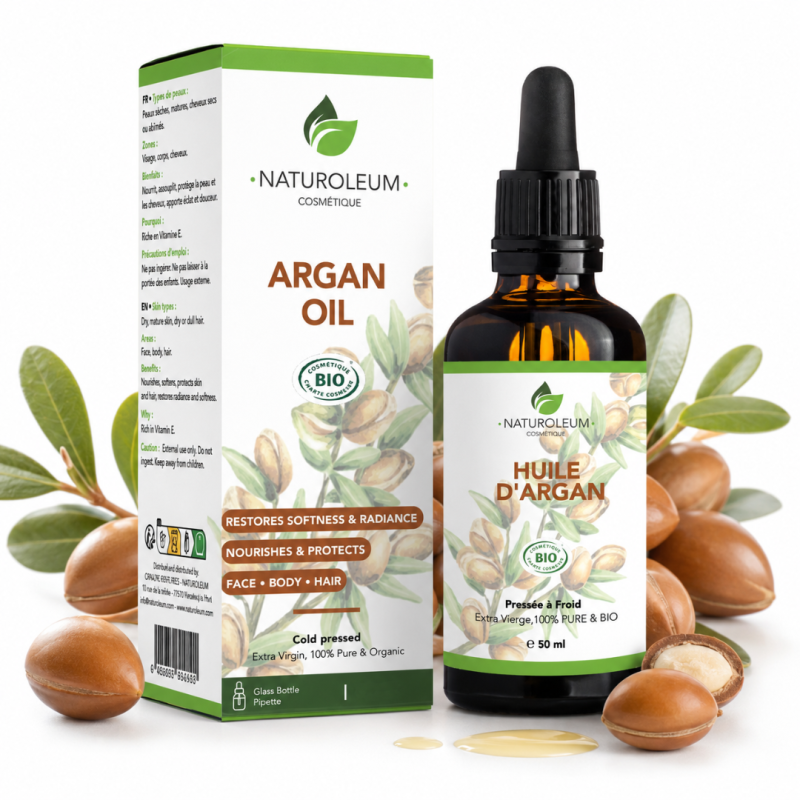
Choose a certified organic, virgin, cold-pressed oil sold in a tinted glass bottle. Our organic argan oil is COSMOS ORGANIC certified by Ecocert and packed in France (ESAT). Store it away from light and heat, tightly closed, and use it within a few months of opening.
FAQ
Is argan oil suitable for oily skin? It is not the best choice for daily use. On oily or blemish-prone skin, prefer jojoba or black seed oil.
Can I apply it in the morning? Yes, in small amounts (2 drops), letting it absorb for a few minutes before make-up.
Does argan oil make hair grow? No, no oil makes hair grow faster. It does, however, limit breakage of the lengths, which helps keep them long.
-10% from 2 oils, -15% from 3, applied automatically in your basket.
Comments : 0